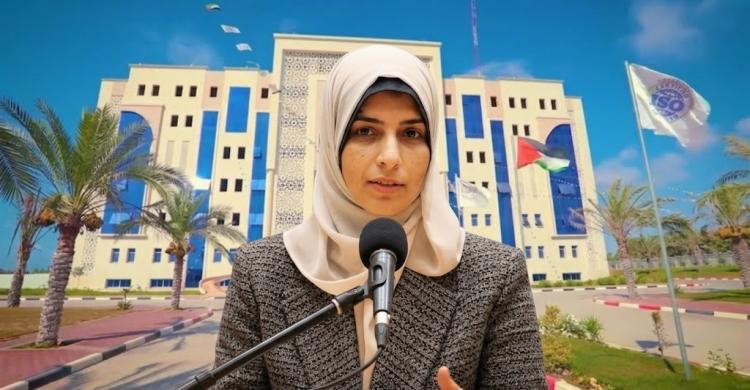
Israa University in Palestine participated in the opening session of the international forum entitled “Gaza at a Historical Crossroads: The Memory of War and Prospects for Peace”, represented by Dr. Asmaa Adnan Al-Shaqaqi, Dean of the Faculty of Humanities and Professor of Educational Media. The forum attracted wide international research participation.
The forum was organized by the Al-Wahrani Academy for Scientific Studies and Cultural Interaction in Oran, Algeria, in collaboration with several academic and research institutions from Iraq, Türkiye, Palestine, the United States, and Indonesia. It was also coordinated with research laboratories at Algerian universities under the subtitle “The Aftermath of War: Political, Social and Economic Approaches to Reconstruction.”
In her address during the opening session, Dr. Al-Shaqaqi conveyed the greetings of the University President, Professor Dr. Alaa Matar, as well as those of the university’s Board of Directors, academic and administrative staff, and students. She expressed her gratitude to Algeria, the Al-Wahrani Academy, and the participating institutions for organizing the forum, which provides a platform for academic dialogue on the consequences of the war on Gaza and the prospects for recovery and reconstruction.
She emphasized that discussing Gaza at a historical crossroads is not limited to the war or statistics relating to casualties and destruction. Rather, it concerns the memory of a people, the identity of a homeland, and the future of generations. She pointed out that Gaza is not defined solely by its destroyed buildings, but also by the memories that remain within its people and the stories preserved by schools, universities, libraries, homes, and elements of cultural heritage. These reflect the story of a people determined to preserve their existence and identity on their land.
A Call to Document the Impact of War and Preserve Collective Memory
Dr. Al-Shaqaqi stressed the responsibility of universities and researchers to document the current period and preserve its memory. She considered documentation a means of safeguarding history for future generations. She explained that the academic mission is not limited to writing about war; it also involves recording its impact, preserving collective memory, transforming suffering into knowledge, and turning knowledge into a vision that contributes to building the future.
She reflected on the experience of Israa University, which was targeted and destroyed, including its university hospital, buildings, facilities, equipment, and academic resources. These represented the culmination of years of academic work, knowledge development, and service to the community.
In this context, she stated: “A university may be destroyed as a physical place, but its mission cannot be destroyed. Its halls may be demolished, but knowledge cannot be demolished.”
She added that the university’s participation in the forum serves as a testimony to what has happened and reflects its responsibility to ensure that the facts and collective memory are preserved for future generations.
Speaking about the prospects for peace, Dr. Al-Shaqaqi emphasized that genuine peace does not simply mean an end to the war. Rather, it requires justice, the preservation of human dignity, the protection of the rights to life and education, the safeguarding of identity and culture, and the rebuilding of people’s lives and educational institutions.
اShe called for solidarity with Gaza to be translated into practical action through scientific research that documents the truth, initiatives that preserve collective memory, academic partnerships that support resilience, and joint efforts that contribute to reconstruction and the shaping of the future.
She concluded her address by affirming that Gaza will write its future through knowledge and education, that Al-Israa University will continue to fulfil its academic mission despite the destruction, and that the memory of past suffering can be transformed into a source of strength for building the future.
International Academic and Research Participation
The opening session featured addresses by several university presidents, directors of research centers, and heads of research laboratories from Algeria, Palestine, Iraq, Indonesia, and the United States. The session was chaired by Professor Dr. Souad Besnasi, President of the Al-Wahrani Academy and General Supervisor of the forum, who officially declared the opening of its proceedings.