Al-Israa University: Scientific Recommendations to Enhance Education Recovery and Support Digital Transformation in Gaza
Gaza – Media Committee
The peer-reviewed international conference organized by Al-Israa University on March 27–28–29, in partnership with Birzeit University, the London Center for Research and Social Consultancy, and Jeel Scientific Research Center, issued a wide range of scientific recommendations. These recommendations reflected a comprehensive academic vision for rebuilding the education system in the Gaza Strip, in light of the unprecedented challenges imposed by the war and the rapid transformations in technology and sustainable development.
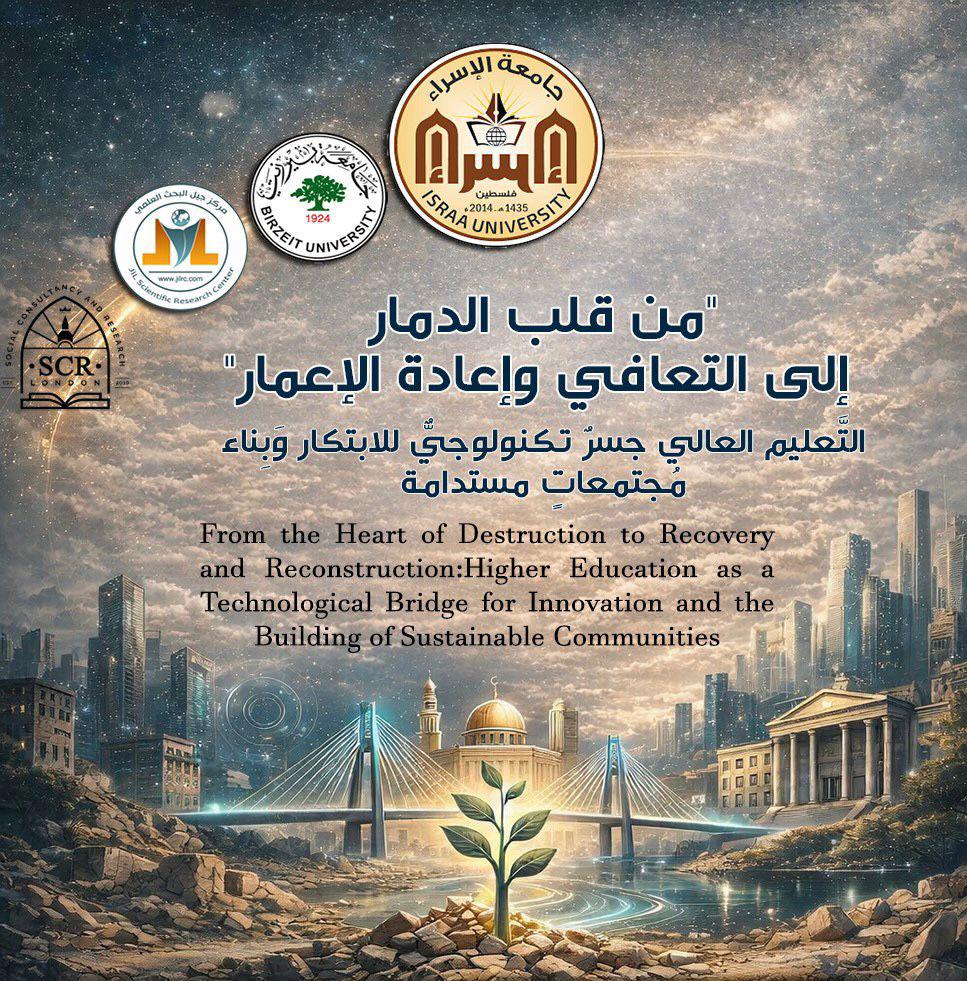
These recommendations were the outcome of in-depth scientific discussions held during the conference titled: “From the Heart of Destruction to Recovery and Reconstruction: Higher Education as a Technological Bridge for Innovation and Building Sustainable Societies.” Based on the findings of more than 54 research papers, the recommendations collectively emphasized that education is no longer merely a service sector, but a strategic pillar for reconstruction and for building a resilient society capable of recovering from the آثار of destruction.
In this context, the recommendations stressed the need to adopt a comprehensive national strategy for managing education in emergency situations, ensuring the continuity of the educational process under all circumstances. This should go hand in hand with a gradual transition toward a blended learning model that combines in-person and digital education, enhancing flexibility and crisis responsiveness. The recommendations also highlighted the importance of developing digital infrastructure and launching a unified national educational platform capable of providing modern, interactive content for students at all levels.
The recommendations also addressed the human and psychological dimension, calling for strengthening psychosocial support programs for students in affected environments, as a fundamental requirement for successful education. They further emphasized the need to develop technical and vocational education and align it with labor market needs, particularly in the fields of the digital and green economy.
At the higher education level, the recommendations focused on redefining the role of universities as active developmental institutions by directing their academic and research programs toward supporting recovery and reconstruction efforts. They also called for strengthening applied scientific research, establishing business incubators and innovation centers to transform ideas into productive economic projects, integrating project-based learning, and expanding practical training programs to prepare graduates with employable skills.
From an economic and strategic perspective, the recommendations urged the private sector to invest in educational technology, support entrepreneurship, and contribute to funding scientific research, thereby enhancing integration between education and the economy. They also called on international institutions to intensify their support for the education sector in affected areas by funding long-term projects that ensure sustainable recovery, promote digital transformation, and open avenues for international academic collaboration.
Regarding curricula, the recommendations emphasized the need for continuous updates and the integration of 21st-century skills, including critical thinking, innovation, and teamwork, alongside the inclusion of concepts such as artificial intelligence, sustainable development, and entrepreneurship to better prepare students for future demands.
Overall, these recommendations reflect a clear scientific direction toward building a flexible, innovation-driven, and technology-based education system capable of withstanding crises and contributing to genuine and sustainable recovery—not only in education, but across society as a whole.
In the background of these outcomes, the conference stands out as an international scientific platform that brought together a distinguished group of researchers and academics from Arab and European countries, including Palestine, Algeria, Morocco, Tunisia, Belgium, Iraq, and Libya. Participants presented multidisciplinary perspectives addressing education in crisis contexts, digital transformation, the green economy, and reconstruction.
This broad international participation confirms that education in Gaza is no longer merely a local issue, but has become a subject of global academic interest, reflecting a growing recognition of the role of knowledge in rebuilding affected societies.