Gaza – Public Relations
Al-Isra University discussed a master’s thesis in the Business Administration program entitled “The Impact of Strategic Intelligence on the Quality of Decision-Making: A Field Study on the Ministry of Awqaf and Religious Affairs in the Southern Governorates.”
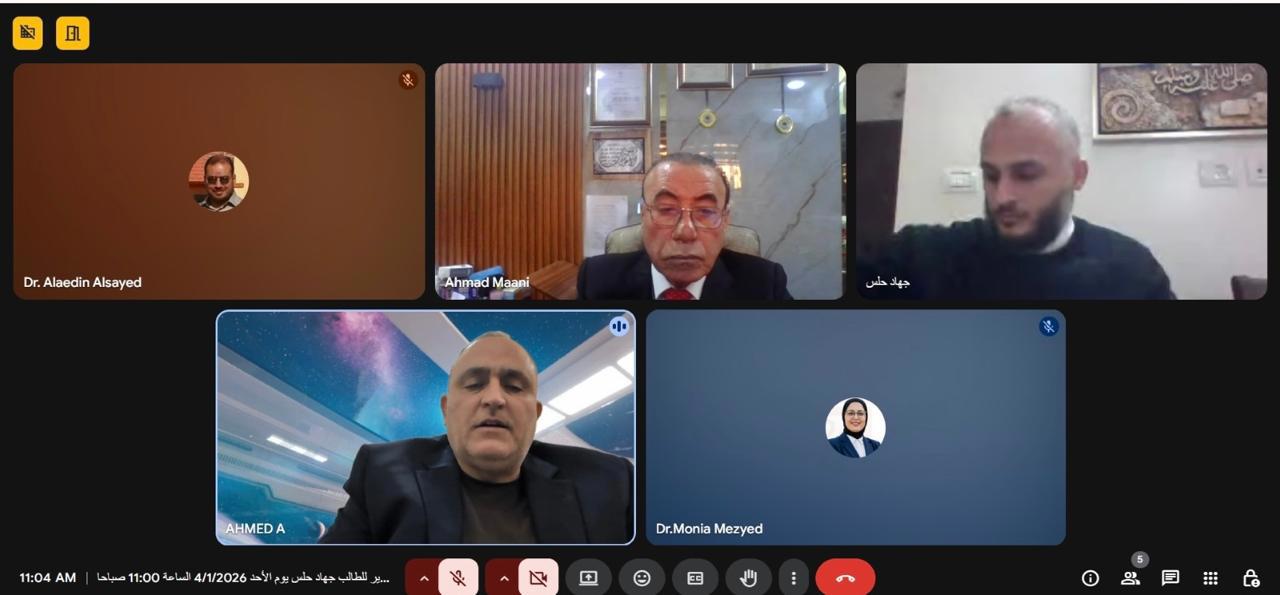
The discussion was held electronically via the Zoom platform, in the presence of the examination and evaluation committee, along with a number of academics and interested attendees.
The examination committee consisted of Dr. Ahmad Ismail Al-Hassaina, the primary supervisor and chair of the committee; Dr. Mahmoud Abdul Rahman Al-Shanti, supervisor; Dr. Ala’ Al-Din Khalil Al-Sayyed, internal examiner; and Prof. Dr. Ahmad Ismail Al-Ma’ani, external examiner from the sisterly Hashemite Kingdom of Jordan.
The session was attended by Dr. Munya Khalil Mazeed, Dean of Graduate Studies; Dr. Samar Atta Allah, Dean of the Faculty of Administrative and Financial Sciences; and Dr. Munther Azzam, Vice President for Administrative and Financial Affairs.
The study aimed to identify the impact of practicing strategic intelligence on improving the quality of decision-making within the Ministry of Awqaf and Religious Affairs in the southern governorates, by analyzing the level of application of its various dimensions and the extent of their reflection on the effectiveness of administrative decisions.
The results showed that the level of strategic intelligence was high, while the level of decision-making quality was moderate. The findings also revealed a strong, positive, and statistically significant correlation between the dimensions of strategic intelligence and the quality of decision-making.
The study recommended enhancing the quality of decision-making by employing the concept of strategic intelligence and applying its influential dimensions, particularly systems thinking, future foresight, and building strategic partnerships. This can be achieved through adopting administrative practices based on analyzing internal and external relationships, expanding areas of strategic cooperation, and enhancing the ability to anticipate future opportunities.
The recommendations also emphasized the importance of focusing on the use of quantitative tools—such as statistical models, data analysis, and forecasting methods—to support evidence-based decision-making characterized by accuracy and objectivity.
It is worth noting that the Faculty of Graduate Studies at Al-Isra University awards master’s degrees in the disciplines of Business Administration, Law, and Accounting and Finance.