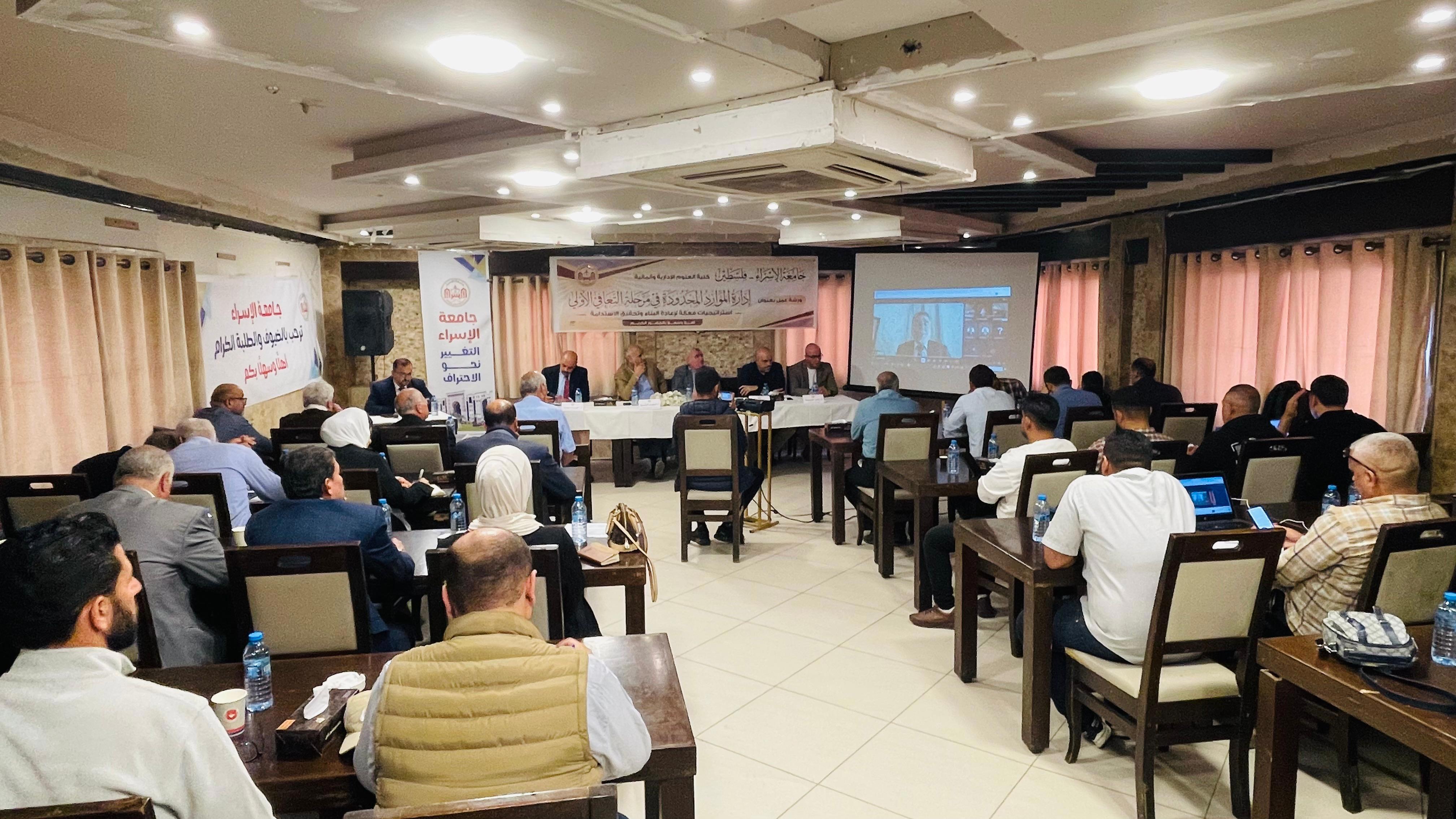
Al-Israa University Reviews Outcomes and Recommendations of a Workshop on Resource Management During the Recovery Phase in Gaza
Gaza – Public Relations
Al-Israa University concluded a scientific workshop titled “Managing Limited Resources During the Recovery Phase in the Gaza Strip,” which addressed the key economic and social challenges facing the sector under current conditions, as well as ways to enhance recovery and reconstruction on sustainable foundations.
The workshop produced a set of findings reflecting the scale of the challenges, highlighting an unprecedented deterioration in the economic system due to the widespread destruction affecting infrastructure and productive sectors, alongside a sharp rise in unemployment and poverty rates, and a significant decline in the contribution of various economic sectors. It also pointed to weak external funding directed toward productive sectors and an imbalance in the distribution of resources and aid, in ways that do not align with the population’s basic needs.
In light of these findings, participants presented a package of practical recommendations aimed at improving resource management efficiency and strengthening recovery pathways. They emphasized the need to institutionalize a national, impact-based priority-setting system to ensure that resources are directed toward vital and productive sectors capable of generating sustainable employment opportunities.
The workshop also recommended enhancing scientific and applied research, and benefiting from academic and research expertise, as well as research centers and institutes in local universities, to prepare studies that contribute effective proposals for maximizing the use of limited resources during the recovery phase.
It further stressed the importance of promoting a shift toward a local and circular economy by recycling available resources and supporting reconstruction projects, thereby reducing reliance on imports and easing pressure on financial resources. The workshop also highlighted the importance of supporting small and medium-sized enterprises through microfinance programs to stimulate economic activity and achieve sustainability.
Additionally, it called for supporting and adopting industrial innovations presented by Palestinian university students by providing accessible financing, offering incentives and administrative facilitation, strengthening training and capacity-building programs, and incubating entrepreneurial ideas.
In a related context, the workshop underscored the importance of developing relief work systems to ensure fairness and efficiency in aid distribution, enhancing community oversight, and benefiting from international experiences in managing recovery and reconstruction phases.
It also emphasized building strategic partnerships among government institutions, civil society organizations, and the private sector, while reinforcing principles of transparency and accountability in resource management, and involving local communities in identifying actual needs. The workshop reaffirmed the importance of supporting innovation and scientific research, and harnessing youth potential—especially within universities—to provide practical solutions to existing challenges.
Participants confirmed that implementing these recommendations would contribute to achieving gradual and sustainable recovery and strengthening the resilience of Palestinian society in the Gaza Strip in facing current challenges.