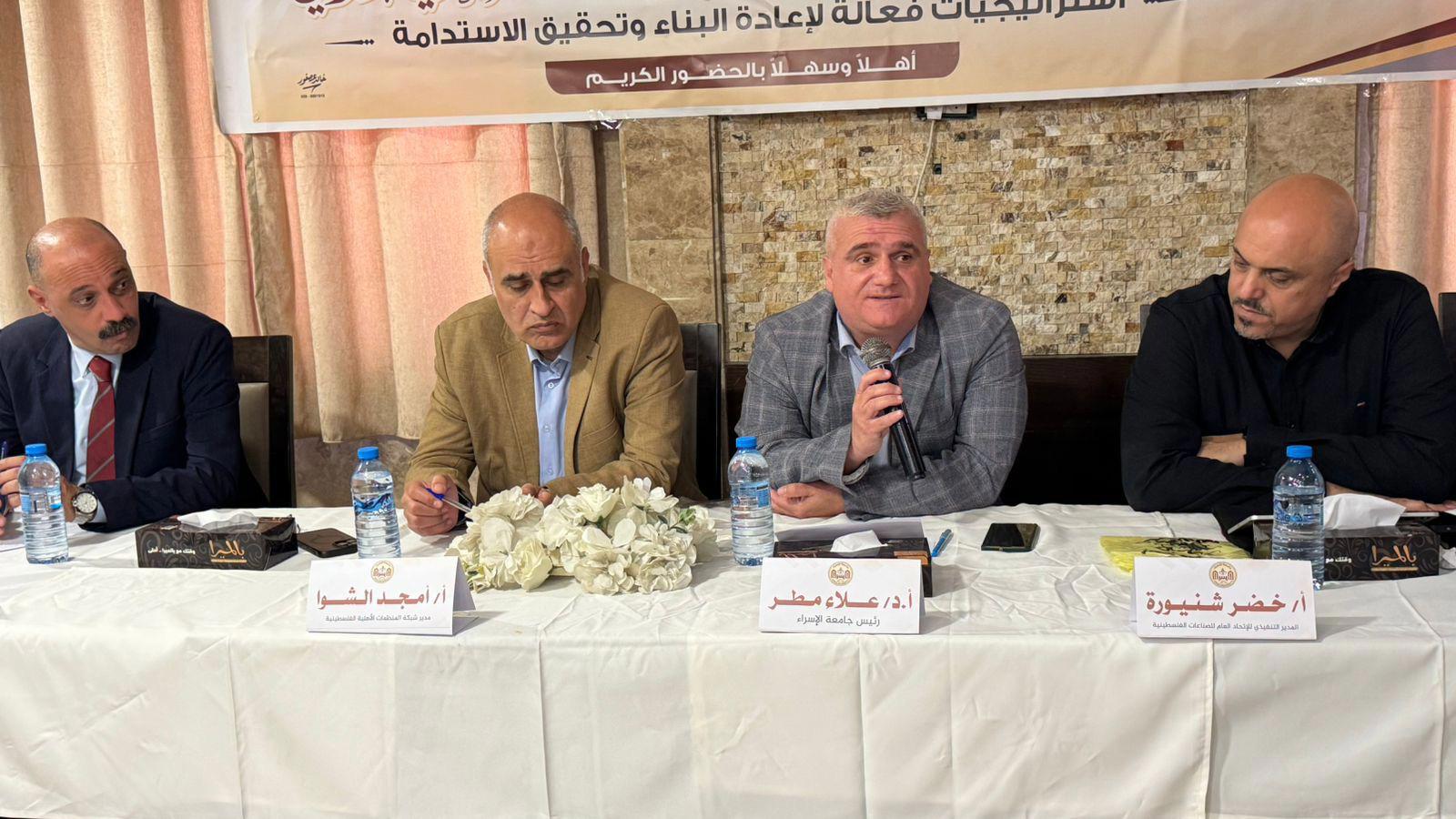
Al-Israa University Organizes a Workshop on Recovery and Reconstruction
Gaza – Public Relations
The Faculty of Administrative and Financial Sciences at Al-Israa University organized a workshop on Sunday (April 18) titled:
“Managing Limited Resources in the Initial Recovery Phase: Effective Strategies for Reconstruction and Achieving Sustainability,” with the participation of a distinguished group of academics, experts, and notable figures.
Participants included Prof. Dr. Alaa Matar, President of the University; Prof. Dr. Jabr Al-Daour, Head of the Education ملف in the National Committee for Managing the Gaza Sector; Mr. Amjad Al-Shawa, Director of the Palestinian NGO Network; Mr. Khader Shneiora, Executive Director of the Palestinian Federation of Industries; Eng. Ahmad Mhanna, Executive Director of the Palestinian Housing Council; and Dr. Ramez Hassouna, Head of the Business Administration Department.
The workshop was attended by a number of academic and administrative staff members, students from the Business Administration Department, as well as representatives of universities, public and private sector institutions, and civil society organizations, in addition to media حضور. It also saw wide participation via “Google Meet.”
The workshop aimed to highlight mechanisms for managing limited resources amid current challenges and to propose practical strategies supporting recovery and reconstruction efforts, with a focus on achieving economic and social sustainability.
In his opening speech, Prof. Dr. Alaa Matar emphasized that this meeting represents an important academic and national milestone during a critical phase that requires conscious and efficient management of limited resources. He noted that organizing this workshop, as the first in-person meeting of its kind, reflects the university’s determination to continue its academic and national mission despite unprecedented challenges. He explained that despite the destruction and targeting it has faced, the university has continued its role by resuming online education and offering broad facilities to students, in addition to admitting new students without financial burdens, believing in everyone’s right to education.
For his part, Prof. Dr. Jabr Al-Daour praised the importance and timing of the workshop, noting that the education sector in Gaza has suffered massive destruction affecting institutions at all levels, including universities. He explained that the losses extended beyond infrastructure to include students, academic staff, and psychological aspects, which calls for intensified efforts toward reconstruction, affirming that there is genuine will to gradually resume the educational process.
Dr. Ramez Hassouna highlighted the importance of the workshop as a platform for exchanging ideas and visions on recovery, stressing that students are a fundamental pillar in the rebuilding process and that empowering them is a priority, alongside strengthening partnerships between institutions.
Mr. Amjad Al-Shawa emphasized the vital role of civil society organizations in supporting community resilience, noting that the scale of challenges requires a coordinated collective response and that the workshop represents an opportunity to unify efforts and translate recommendations into practical steps.
Mr. Khader Shneiora pointed to the scale of losses suffered by the industrial sector, noting that recovery is progressing gradually according to available resources, and called for supporting and adopting students’ creative and research projects.
Eng. Ahmad Mhanna explained that recovery begins with people as the محور of the reconstruction process, highlighting the role of the Palestinian Housing Council in supporting affected families and providing shelters despite challenges related to limited resources, and expressing hope for enhanced cooperation with the university.
Student Mousa Shallah delivered a speech on behalf of the students, expressing appreciation for organizing the workshop and emphasizing its importance in linking theory with practical application. He called for supporting student entrepreneurial initiatives and providing an enabling environment to develop their skills and strengthen their role in serving society.
The workshop was moderated by Dr. Ihab Abu Al-Khair, Director of Public Relations at the university, who welcomed participants and opened the floor for discussion, enriching the workshop’s themes with valuable contributions.
At the conclusion of the workshop, Dr. Badr Hamdan presented the أبرز outcomes and recommendations, stressing the need to build upon them and translate them into practical implementation steps that contribute to supporting recovery and reconstruction efforts.