President of Al-Isra University Participates in Launch of “Scientific Café” Events on Gaza at Turkish Universities
Gaza – Public Relations
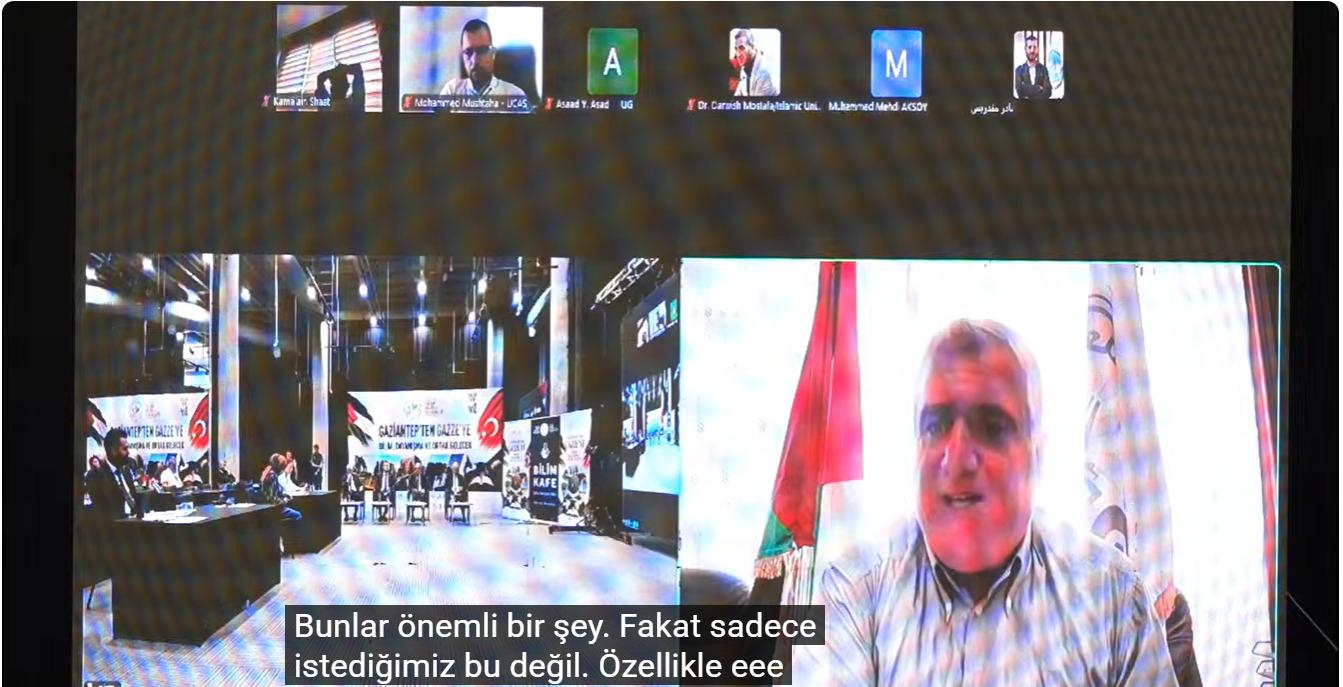
Professor Dr. Alaa Matar, President of Al-Isra University – Palestine, participated today via video conference in the launch of a series of “Scientific Café on Palestine, with a particular focus on the Gaza Strip” events, organized by Turkish higher education institutions from September 1 to 21 as part of the “Solidarity with Gaza Universities” program. The program was coordinated by the Turkish Council of Higher Education (YÖK) with the aim of strengthening solidarity with students, academics, and universities in Gaza. The first event was launched by Gaziantep Islamic Science and Technology University (GİBTÜ).
The event was attended by Palestinian Minister of Education and Higher Education Professor Dr. Amjad Barham, President of the Turkish Council of Higher Education Professor Dr. Erol Özvar, and President of Gaziantep Islamic Science and Technology University Professor Dr. Şeyhmus Demir, along with the Governor of Gaziantep, Fatma Şahin, Mayor of Gaziantep Metropolitan Municipality, as well as a number of presidents of Palestinian universities, academics, students, and community figures.
The event aimed to highlight the state of higher education in Palestine, particularly in the Gaza Strip, strengthen academic and scientific cooperation between Turkish and Palestinian universities, and move from humanitarian solidarity toward practical and sustainable academic partnerships.
During his address, Professor Dr. Matar presented Al-Isra University’s experience in confronting the repercussions of the war and the destruction that affected its buildings, laboratories, and resources. He emphasized that the university has continued to fulfill its educational and academic mission despite the exceptional circumstances.
He explained that the university adopted online education, provided alternatives to face-to-face learning, and strengthened its partnerships with universities and academic institutions locally and internationally. These efforts enabled students to continue their studies and complete their graduation requirements, while scientific research, academic publishing, and practical training also continued.
Professor Dr. Matar emphasized that institutional resilience has become essential for ensuring the sustainability of higher education during crises. He called for supporting Palestinian universities through sustainable partnerships that include hosting students and researchers, providing training opportunities, developing joint research projects, offering academic supervision, and facilitating access to laboratories and digital platforms.
He concluded his address with a message of hope, saying:
“The university campus may be destroyed, but the university cannot be destroyed. The stone may fall, but knowledge remains. This is the true meaning of the university’s resilience: that education continues and that the future remains possible.”
Al-Isra University’s participation in this event comes as part of its efforts to strengthen the university’s presence in international academic forums, highlight the experience of Palestinian higher education in confronting crises, and open new avenues for international academic and research cooperation that serve students and researchers and support the recovery and advancement of the higher education sector in Palestine.