Israa University Discusses a Legal Study on the Prospects of the Legal Framework for Transitional Administration in the Gaza Strip
Gaza – Public Relations
Isra University organized a specialized legal forum to discuss a study entitled “The Legal Framework for Transitional Administration in the Gaza Strip in Light of UN Security Council Resolution No. 2803 of 2025, the Charter of the Peace Council, and its Resolution No. 1 of 2026.” The study was prepared by Mr. Munir Saeed Al-Aqbi and Dr. Sharif Baalusha.
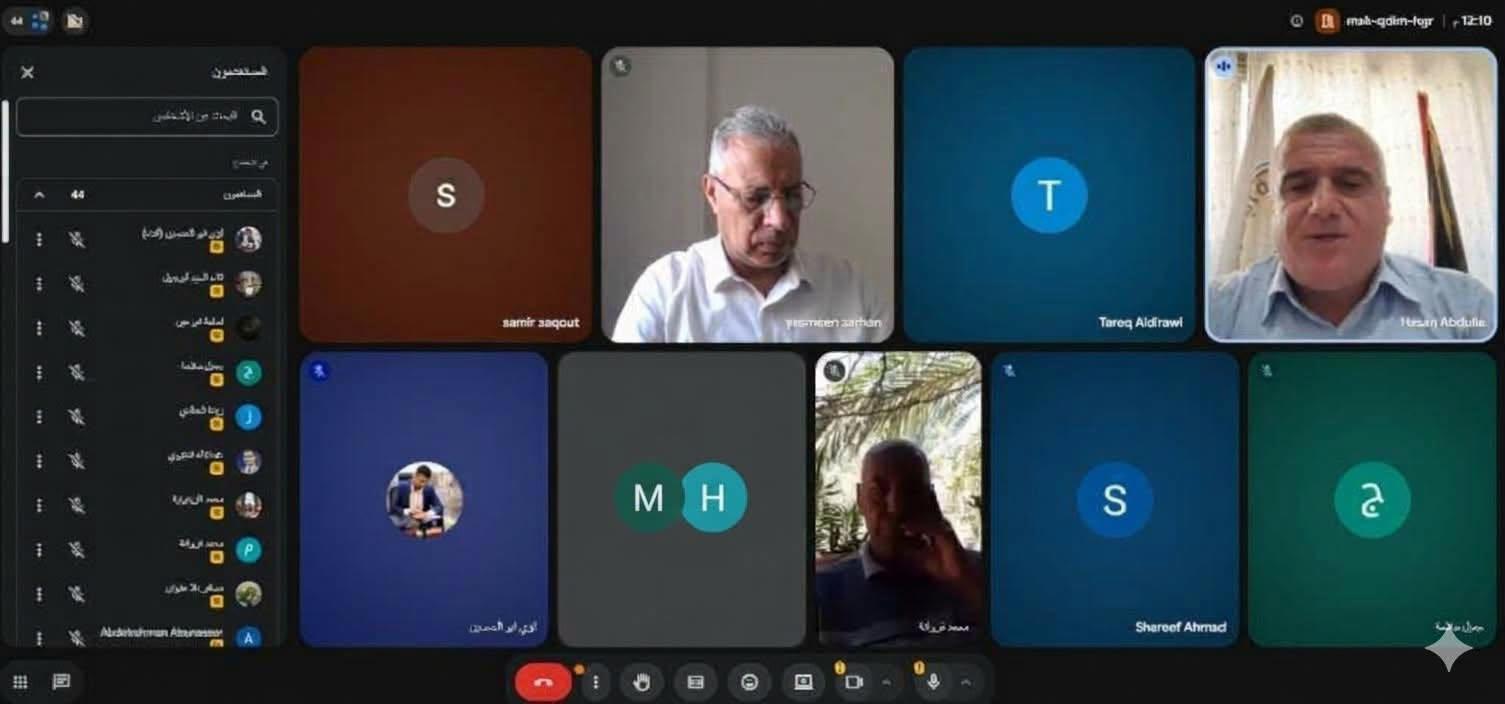
The forum was attended by Eng. Omar Al-Hindi, Chairman of the University’s Board of Trustees; Prof. Dr. Alaa Matar, President of the University; Dr. Munther Azzam, Dean of the Faculty of Law; and a group of academics, legal professionals, human rights experts, researchers, members of the university community, and other interested participants via Google Meet.
At the beginning of the forum, moderated by Dr. Tareq Al-Dairawi, Associate Professor at the Faculty of Law, Mr. Munir Saeed Al-Aqbi presented the study, addressing its subject, significance, objectives, and methodology. He explained that the study examines the legal and regulatory framework governing transitional administration in the Gaza Strip, including the structures, entities, and powers associated with it, in light of UN Security Council Resolution No. 2803 of 2025, the Charter of the Peace Council, and its Resolution No. 1 of 2026.
University President Prof. Dr. Alaa Matar emphasized that the importance of the study stems from its relevance to a sensitive stage in which issues of law, administration, institutions, rights, and the future of public life in the Gaza Strip intersect. He noted that the university views academic research as an essential tool for understanding the transformations taking place in society, analyzing and documenting their implications, and anticipating their future trajectories.
Prof. Dr. Matar added that Isra University, which has continued its educational and research mission despite the circumstances of war and significant challenges, remains committed to producing knowledge on issues affecting the present and future of Palestinian society. He stressed that the current stage requires rigorous academic studies and multidisciplinary approaches that contribute to developing Palestinian knowledge capable of understanding and analyzing reality.
For his part, Dr. Munther Azzam, Dean of the Faculty of Law, explained that the study constitutes a legal contribution to the analysis of transitional arrangements for the administration of the Gaza Strip. It examines their legal foundations, the nature of the powers granted to the structures and entities established under these arrangements, and their relationship with the principles of international law and the Palestinian Basic Law.
The study reached a number of conclusions, most notably that certain provisions and powers set out in the Charter of the Peace Council and its Resolution No. 1 of 2026, according to the researchers’ analysis, go beyond the framework established by UN Security Council Resolution No. 2803 of 2025. This raises legal and institutional questions concerning the scope of certain powers and authorities granted to the entities established under the arrangements.
The researchers emphasized that any transitional arrangements should be based on respect for Palestinian legal sovereignty and the unity of the constitutional and legal system. They further stressed that such arrangements should not result in the establishment or entrenchment of permanent institutions that could undermine the legal and political personality of the State of Palestine. They also called for ensuring the independence of the judiciary and its subjection to the provisions of the Palestinian Basic Law, the applicable Judicial Authority Law, and all other constitutional and legal safeguards.
The forum included a discussion and interventions from participants addressing the legal and institutional dimensions of the transitional phase, as well as the importance of the study in enriching Palestinian legal and human rights research amid current developments.
At the conclusion of the forum, Dr. Sharif Baalusha responded to participants’ questions and comments, contributing to a broader discussion of the study and its legal prospects.
For the full study:
The Legal Framework for Transitional Administration – 2026.pdf – Google Drive